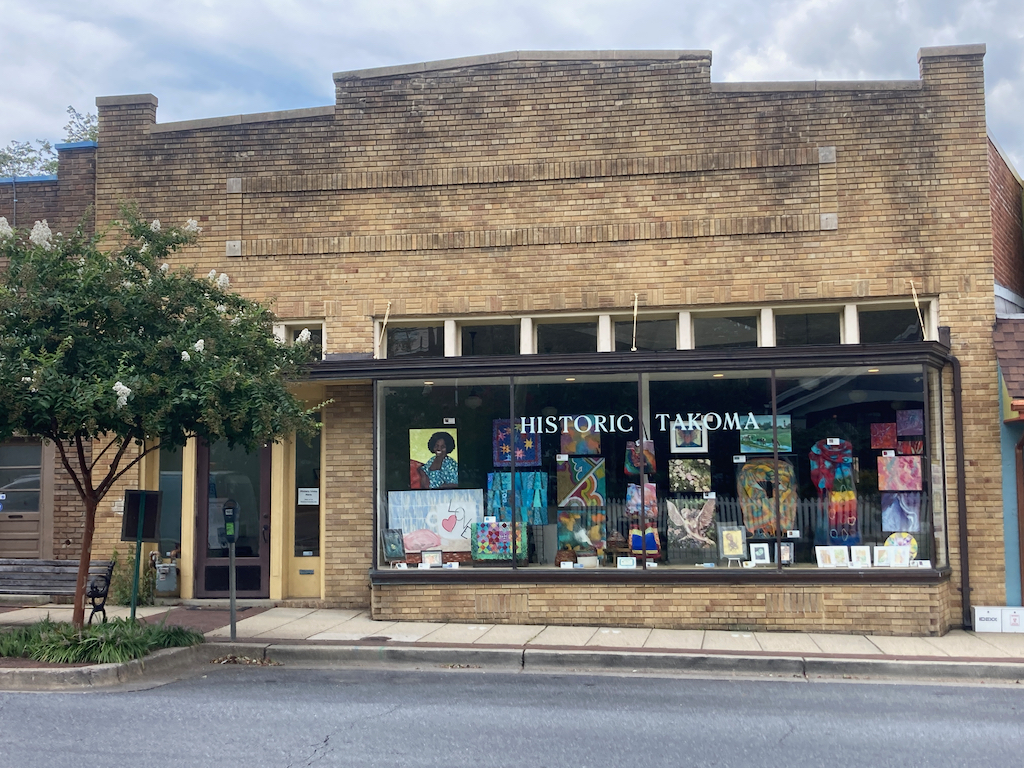
Historic Takoma
History Lives Here
History Lives Here

“The Coffee House” was an arts and public affairs TV magazine that aired from 1996 to 2010. Born as “Takoma Coffee House,” it originated from the Takoma Park (Maryland) Municipal Building, airing exclusively on the City’s cable channel. The program moved its production to Montgomery Community Television (now known as MCM, Montgomery Community Media) in 1997 and, thereafter, was recorded live-on-tape. The Coffee House won numerous national and local public access awards and ultimately aired on 80 channels, Free Speech TV, the Dish Satellite, and the internet.
The Coffee House shows are preserved in the “Coffee House Collection” in Historic Takoma’s archives. Each of the shows is available through links to YouTube. A show “rundown” summarizes each show, contains the show links, and is searchable for content.
Over a beer in 1995, then-Takoma Park resident Mark Cohen and then-Takoma Park Council Member Larry Rubin mulled over the state of the municipality’s cable channel, which at the time aired Council meetings, video of the 4th of July Parade, and a bulletin board. That was all. The video and audio quality was spotty at best. Cohen noted the wealth of artists and activists in Takoma Park who could be featured on the channel. Rubin challenged Cohen, a former public radio news director, to join a Cable Advisory Board and do something about it. Cohen accepted the challenge and thus was born the Takoma Coffee House.
It was an ensemble from the beginning. Cohen invited a core of Takoma Park’s finest to join him as hosts of different segments, including Howard Kohn (sports and journalism), David Eisner. (roots music), Cathy Kristiansen (health), and Lisa Page (literature). Over time, the roster of hosts expanded to include Liz Lerman (dance), Pat Aufderheide (film), Fred Feinstein (labor), Angela J. Davis (law and justice), Reuben Jackson (literature), Mike Tidwell (environment), Welmoed Laanstra (visual arts), and Jamie Raskin (government). Cohen anchored a public affairs segment. From the start, the program featured poets, spoken-word artists, and musicians.
The Coffee House was a labor of love: No producer, host, crew member, or guest was paid to participate. The show relied on one hundred or so volunteers. They operated the cameras, ran the audio board, the character generator, the tape decks, etc. Thanks to Yen Ming-Chen and Ally Potter for directing most of the episodes. A big thanks to Dick Terrill who, month in and month out, reliably set the studio lights and much more, and Ray Davis, who facilitated the transition from the Takoma Municipal Building to real studios at Montgomery Community Television. And a very special thanks to Dee Willett, who deftly recruited, organized and fed the crew, and ably filled in whenever there were any gaps.
While there were no salaries to pay, there were considerable production and distribution costs, and we did feed the production crews. Thanks to the House of Musical Traditions, and, posthumously, to Mark’s Kitchen, Chuck & Dave’s, and Video Americain for their generous support, the Carl M. Freeman Foundation, and especially to the Arts and Humanities Council of Montgomery County.
Over its 14 years, The Coffee House navigated substantial change in technology. In its early years, the program was recorded on 3/4-inch video tape. To control costs, Montgomery Community Television transitioned to S-VHS video tape, a lesser quality than 3/4-inch but a higher analog grade than VHS. Around 2002, The Coffee House moved to “mini-DV” tape, which provided comparable quality to ¾-inch. It also enabled Cohen to digitally edit the show at home with Final Cut Pro software.
The quality differences in the generations of tape are evident in the collection. And there are occasional audio dropouts and video glitches. There are some gaps, most notably, for all of 1996. We were unable to locate copies of the tapes produced at the Takoma Park Municipal Building. So Episode #1 of the collection instead begins with 1997 when we moved production to Montgomery Community Television. (To retrospectively account for the nine missing 1996 episodes, we arbitrarily left out Episodes #79 through #87.)

Ross Adams
Elias Agritellis
Jimmy Albert
Stacy Allgood
Pat Aufderheide
Naomi Ayala
Ed Bager
Michelle Barratt
Margo Bansda
Darlene Bell-Zuccarelli
Eileen Binns
Joann Birkenstock
Michael Boblitt
Josh Boehr
Eric Bond
Spike Bowden
William Brown
John Buckley
Margaret Buckley
Cintia Cabib
Michael Camillo
Bob Cavedo
Bob Chanin
Jay Chapin
Mauro Ciachetti
Mark Cohen
Jim Colwell
Rob Creager
William Davenport
Angela J. Davis
Ray Davis
Randy Debnam
Peter Dimuro
Joe Dincau
Charles Dukes
Flo Dwek
John Eftimiades
Aaron Evrard
David Eisner
Fred Feinstein
David George
George Geesey
Susan Glick
Alice Gordon
Merrill Hessell
Tom Hoopengardner
Isaac Isare
Reuben Jackson
Cameron Jones
Linda Kaye Jones
James Katz
Kimberly Keese
Mike Kengla
Patrick Kenny
Howard Kohn
Cathy Kristiansen
Dario Lanzano
Judy Laszcz
George Lawrence
Liz Lerman
Robert Mattia
Mat MacIntyre
Denny May
Richard McCann
Larry Merewitz
Marian Merewitz
Donna Merrifield
Dagmar Mika
Yen Min-Chen
Tchad Moore
Carolyn Murphy
Nancy O’Donnell
Steve Olson
Lisa Page
Sorin Pasarin
Ally Potter
Dalton Potter
Jamie Raskin
Brett Reilly
Christine Rossi
Michael Roth
Larry Rubin
Roberta Schoen
Andrew Schou
Brad Shellgren
Paul Silverman
Michael Edward Staley
Eric Straw
Marge Sheehan-Swanke
Demetrius Sykes
Aboucar Sylla
T.K. Smith
Dick Terrill
Patrick Thorpe
Mike Tidwell
Dee Willett
Jett Wyatt
Francine Wyron